
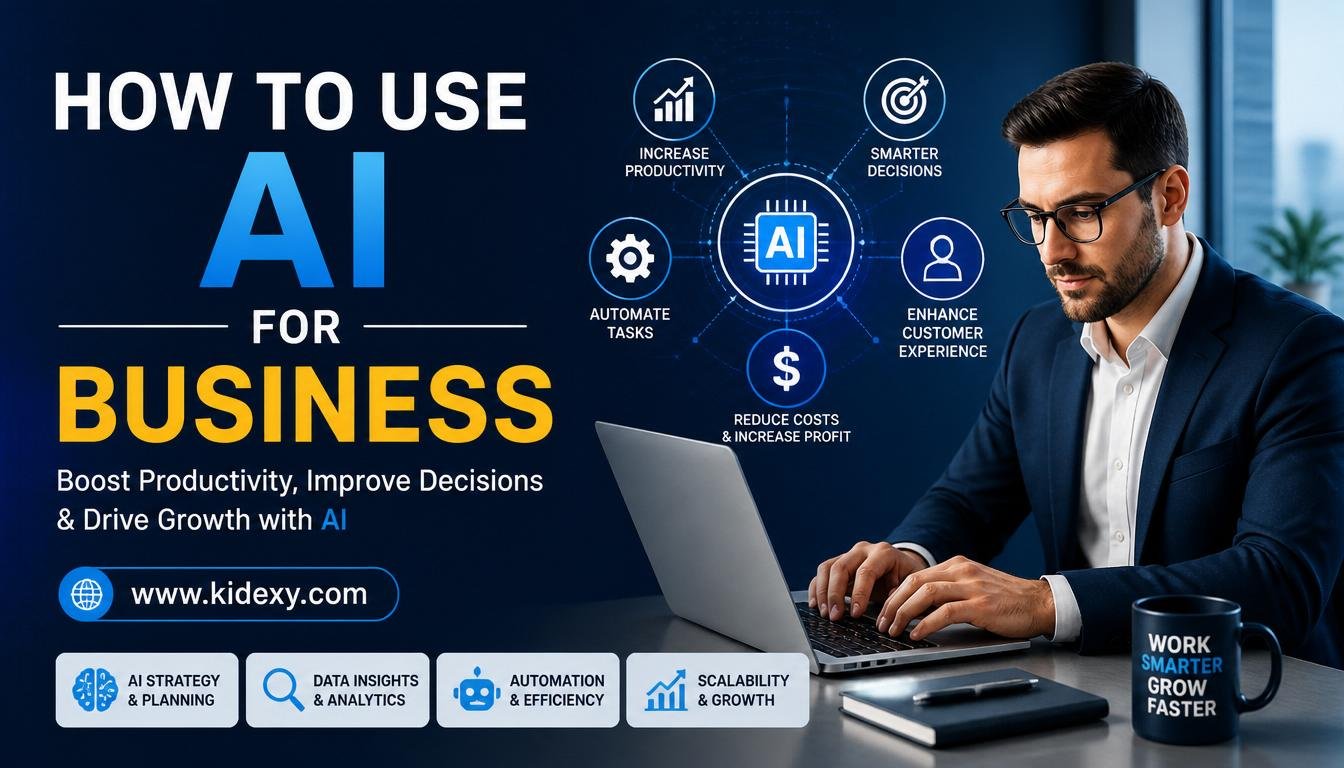
Artificial intelligence is no longer a futuristic concept reserved for large technology companies. Today, businesses of every size are discovering practical ways to improve productivity, enhance customer experiences, and make better decisions with AI-powered tools. From automating repetitive tasks to generating valuable insights from data, AI has become an accessible solution for organizations looking to stay competitive in a rapidly changing marketplace.
Learning How to Use AI for Business is not about replacing employees or completely changing the way your company operates. Instead, it is about finding smarter ways to support your team, reduce manual work, and create more efficient workflows. Whether you run a small business, manage an online store, or lead a growing enterprise, understanding AI can help you unlock new opportunities while saving valuable time and resources.
Understanding AI in Business
Artificial intelligence refers to computer systems that can perform tasks typically requiring human intelligence. These tasks include analyzing information, recognizing patterns, generating content, answering questions, predicting outcomes, and automating repetitive processes. Modern AI tools are designed to assist businesses rather than replace human expertise.
Companies across different industries are adopting AI because it simplifies complex work while improving accuracy. Marketing teams use it to create content, customer support teams rely on chatbots to answer common questions, and financial departments use predictive analytics to identify trends. Instead of handling every task manually, businesses can use AI to streamline daily operations and focus more on strategic growth.
What Artificial Intelligence Means for Businesses
In a business environment, AI serves as a digital assistant capable of processing large amounts of information much faster than humans. It can identify customer preferences, analyze market trends, and provide recommendations based on real-time data. This enables organizations to make informed decisions without spending countless hours reviewing reports.
The technology has also become much easier to access. Cloud-based platforms and user-friendly AI applications allow businesses to adopt intelligent solutions without building complex software from scratch. As a result, companies of all sizes can benefit from automation and advanced analytics regardless of their technical expertise.
Why AI Is Becoming Essential
Businesses operate in highly competitive markets where speed and efficiency often determine success. AI helps organizations respond faster to customer needs while reducing repetitive workloads that consume valuable employee time. Teams can dedicate more energy to creativity, problem-solving, and relationship building instead of routine administrative tasks.
Another major advantage is improved decision-making. AI systems analyze large datasets quickly, helping business owners identify opportunities, predict customer behavior, and minimize costly mistakes. These insights allow organizations to make confident decisions backed by reliable information rather than assumptions.
Identifying Business Areas Where AI Delivers Value
AI provides value across nearly every department within an organization. Rather than limiting its use to a single function, businesses often discover multiple opportunities where automation and intelligent analysis improve productivity and efficiency. The key is identifying tasks that consume significant time while following predictable patterns.
Starting with a few targeted applications allows organizations to experience measurable improvements before expanding AI into other areas. This gradual approach minimizes risk while helping employees become comfortable with new technologies.
Marketing and Content Creation
Marketing teams have embraced AI because it simplifies many creative and analytical tasks. AI-powered writing assistants can generate blog ideas, draft email campaigns, create product descriptions, and suggest engaging social media captions. These tools reduce the time required to produce high-quality marketing materials while maintaining consistency.
Beyond content creation, AI supports search engine optimization by identifying keyword opportunities, analyzing competitors, and recommending content improvements. Marketers can also personalize campaigns based on customer behavior, increasing engagement and improving conversion rates without manually segmenting audiences.
Customer Service and Support
Customer expectations continue to rise, making fast and reliable support essential for every business. AI-powered chatbots provide instant responses to common questions, allowing customers to receive assistance at any time of day. This reduces wait times while freeing support agents to focus on more complex inquiries.
AI can also summarize customer conversations, categorize support tickets, and recommend solutions based on previous interactions. These capabilities improve response quality while helping businesses deliver consistent service across multiple communication channels.
Sales and Lead Generation
Sales teams benefit from AI through improved lead qualification and customer relationship management. Intelligent systems can analyze customer interactions, identify promising prospects, and recommend personalized follow-up strategies that increase the likelihood of successful conversions.
Automation also reduces repetitive administrative work. Sales representatives spend less time updating records or scheduling reminders and more time building relationships with potential customers. AI-generated insights help prioritize opportunities, ensuring that valuable leads receive timely attention.
Operations and Administration
Administrative work often involves repetitive processes that consume valuable business resources. AI simplifies these activities by organizing documents, summarizing meetings, managing schedules, and automating routine workflows. Employees spend less time on manual tasks while maintaining higher accuracy.
Workflow automation also improves collaboration across departments. Information moves more efficiently between teams, reducing delays and minimizing human error. As businesses grow, these efficiencies become increasingly valuable because they support higher workloads without requiring significant increases in staffing.
Finance and Business Analytics
Financial management depends on accurate data and timely insights. AI assists finance teams by analyzing spending patterns, forecasting budgets, and identifying unusual transactions that may require further investigation. These capabilities help businesses maintain healthier financial operations while reducing manual reporting.
Business analytics has also become more accessible through AI-powered dashboards that transform complex data into easy-to-understand visual reports. Decision-makers can quickly evaluate performance metrics, monitor trends, and identify areas requiring improvement without extensive technical knowledge.
Choosing the Right AI Tools for Your Business
Selecting AI software should begin with a clear understanding of your business goals rather than chasing the latest technology trends. Different organizations have unique priorities, and the best solution depends on the problems you want to solve. Choosing tools that align with your objectives ensures better results and a stronger return on investment.
Businesses should also consider future growth when evaluating AI platforms. Scalable solutions allow organizations to expand their capabilities without replacing existing systems. Investing in flexible technology reduces long-term costs while supporting continuous innovation.
Factors to Consider Before Selecting AI Software
Before adopting any AI solution, evaluate how well it integrates with your current workflows. Easy implementation minimizes disruption while allowing employees to adapt more quickly. User-friendly interfaces also reduce training requirements, encouraging faster adoption across teams.
Security is another essential consideration. Businesses should choose platforms that protect sensitive information through strong privacy controls and compliance with industry regulations. Reliable customer support, regular software updates, and transparent pricing also contribute to a successful long-term investment.
Budget should be considered carefully, but cost alone should not determine the final decision. A slightly more expensive solution that delivers better automation, stronger analytics, and higher reliability often provides greater value over time than a cheaper alternative with limited capabilities.
Popular Categories of AI Tools
Businesses can choose from a wide variety of AI solutions designed for different functions. Writing assistants help create marketing content and internal documents, while image generation tools support branding and creative campaigns. Customer support platforms improve communication through intelligent chatbots and automated responses.
Automation software connects multiple business applications, eliminating repetitive manual work across departments. Analytics platforms transform raw business data into actionable insights, helping leaders make informed decisions with greater confidence. Selecting the right combination of these tools enables businesses to improve efficiency while supporting sustainable growth.
How to Implement AI Successfully
Learning How to Use AI for Business successfully requires more than simply subscribing to an AI platform. The most effective approach is to start with a clear strategy and gradually introduce AI into your daily operations. Businesses that rush into implementation without proper planning often struggle to achieve meaningful results. By focusing on specific goals and measuring progress, companies can maximize the value of their AI investment.
Every business has unique challenges, so there is no one-size-fits-all solution. Instead of trying to automate every department at once, begin with one area where AI can make an immediate impact. As your team becomes more comfortable with the technology, you can expand its use across other business functions.
Start with Clear Business Objectives
Before investing in AI tools, identify the business problems you want to solve. Whether your goal is improving customer service, reducing administrative work, increasing sales, or creating marketing content faster, having measurable objectives makes implementation much easier.
Clear goals also help you evaluate whether AI is delivering real value. Businesses that regularly track productivity, customer satisfaction, and operational efficiency are better positioned to improve their AI strategies over time.
Train Your Team
Technology delivers the best results when employees know how to use it effectively. Provide practical training sessions that demonstrate how AI can simplify daily tasks while explaining its limitations. Team members should understand that AI supports their work rather than replacing their expertise.
Encourage employees to review AI-generated content before publishing or sharing it. Human oversight ensures quality, maintains your brand voice, and prevents mistakes that automated systems may occasionally produce.
Test Before Expanding
Rather than implementing AI throughout the entire organization immediately, begin with a small pilot project. Test one workflow, collect feedback from employees, and measure the results before expanding to other departments.
This gradual approach reduces risk and allows your business to improve processes before making larger investments. Small improvements often lead to significant long-term gains as employees become more confident using AI.
Best Practices for Using AI in Business
Businesses that understand How to Use AI for Business effectively know that AI works best alongside human expertise. Automation increases efficiency, but creativity, strategic thinking, and relationship building remain responsibilities that people perform exceptionally well.
Following proven best practices allows businesses to gain maximum value while reducing potential risks associated with AI adoption.
Combine Human Expertise with AI
Artificial intelligence can generate reports, summarize information, create marketing content, and analyze customer data within seconds. However, final decisions should always involve human judgment. Reviewing AI-generated work improves accuracy while maintaining quality standards.
Successful businesses treat AI as a productivity assistant rather than a complete replacement for experienced professionals. This balanced approach produces better results and strengthens customer trust.
Protect Business Data
AI systems often process valuable business information, making security an essential priority. Choose reputable platforms that offer strong privacy protections, encryption, and compliance with industry standards.
Employees should also understand what information should never be entered into AI tools. Establishing clear internal policies helps protect confidential business and customer data while reducing security risks.
Continuously Improve AI Workflows
Artificial intelligence continues evolving rapidly, and businesses should review their AI processes regularly. Monitor performance, gather employee feedback, and refine workflows to improve efficiency over time.
Updating prompts, experimenting with new features, and measuring business outcomes ensures AI continues supporting your long-term objectives instead of becoming outdated.
Common Mistakes Businesses Should Avoid
Many organizations expect AI to solve every challenge immediately. While AI is incredibly powerful, success depends on proper implementation, employee involvement, and continuous improvement.
Understanding common mistakes helps businesses avoid unnecessary costs while achieving better long-term results.
Depending Entirely on AI
One of the biggest mistakes is relying completely on automated systems without reviewing their output. AI can occasionally produce inaccurate or outdated information, making human oversight essential.
Businesses should always verify important reports, customer communications, and published content before sharing them publicly.
Ignoring Data Quality
AI performs best when it receives accurate and organized information. Poor-quality data leads to unreliable insights, inaccurate predictions, and weak business decisions.
Regularly updating databases and maintaining clean records significantly improves AI performance across every department.
Choosing the Wrong AI Solution
Many companies purchase AI software simply because it is popular. Instead, evaluate tools based on your business goals, budget, ease of use, and compatibility with existing systems.
Selecting technology that solves real business problems delivers greater value than choosing software with unnecessary features.
Failing to Train Employees
Without proper training, employees may hesitate to use AI or use it incorrectly. Continuous education helps teams gain confidence while ensuring consistent adoption across the organization.
Businesses should encourage experimentation while providing clear guidelines for responsible AI usage.
Overlooking Privacy and Security
Protecting customer information should always remain a priority. AI platforms should meet security standards and comply with applicable privacy regulations before they become part of your business operations.
Regular security reviews help reduce risks while maintaining customer confidence.
Real-World Examples of AI in Business
The easiest way to understand How to Use AI for Business is by looking at practical examples. Businesses across multiple industries already use AI to increase efficiency, reduce costs, and improve customer experiences.
These real-world applications demonstrate that AI is valuable for both small businesses and large enterprises.
Small Business Applications
Small businesses use AI to create marketing content, answer customer questions, schedule appointments, manage invoices, and automate repetitive office tasks. These improvements save valuable time while allowing owners to focus on growing their businesses.
Affordable cloud-based AI solutions have made advanced technology accessible to companies with limited budgets.
E-commerce Success Stories
Online stores use AI to recommend products, personalize shopping experiences, forecast inventory demand, and analyze customer behavior. Personalized recommendations often improve customer satisfaction while increasing sales.
AI also helps retailers identify purchasing trends and optimize pricing strategies based on market conditions.
Marketing Automation
Marketing teams rely on AI to write blog posts, create email campaigns, generate social media content, optimize SEO strategies, and analyze campaign performance. Automation reduces manual work while improving overall marketing efficiency.
Businesses can produce consistent, high-quality content faster without sacrificing creativity.
Customer Service Improvements
AI-powered chatbots provide instant responses to frequently asked questions, allowing customer support teams to focus on complex issues. Businesses also use AI to summarize conversations, categorize support tickets, and recommend solutions based on previous interactions.
This combination of automation and human expertise improves customer satisfaction while reducing response times.
Future of AI in Business
As technology continues evolving, understanding How to Use AI for Business will become even more valuable. AI capabilities are expanding rapidly, offering smarter automation, better analytics, and increasingly personalized customer experiences.
Businesses that stay informed about emerging trends will be better prepared to compete in an increasingly digital economy.
Emerging AI Trends
Generative AI, predictive analytics, intelligent automation, and advanced business intelligence are transforming industries worldwide. These technologies help organizations make faster decisions while improving productivity.
Future innovations will continue making AI easier to use, allowing businesses of every size to benefit from intelligent automation.
Opportunities for Every Business
Large organizations often implement AI across multiple departments, while smaller businesses focus on practical tools that deliver immediate value. Regardless of company size, AI creates opportunities to improve efficiency and customer satisfaction.
Organizations willing to embrace innovation while maintaining responsible practices will remain competitive for years to come.
Preparing for an AI-Driven Workplace
Preparing for the future means investing in both technology and people. Businesses should encourage continuous learning, strengthen digital skills, and create a workplace culture that embraces innovation.
Combining AI with skilled employees creates stronger teams, better decision-making, and sustainable business growth.
Conclusion
Understanding How to Use AI for Business is no longer optional for organizations that want to remain competitive. AI can improve marketing, customer service, sales, operations, and decision-making while reducing repetitive work and increasing overall productivity.
The key to success is adopting AI strategically. Start with clear goals, choose the right tools, train your employees, protect your data, and continuously improve your processes. Businesses that combine intelligent automation with human expertise will be well positioned for long-term success in an increasingly AI-driven world.
Frequently Asked Questions
What is the easiest way to start using AI in a business?
Begin with repetitive tasks such as content creation, customer support, scheduling, or data analysis. Start small and expand after seeing measurable results.
Can small businesses benefit from AI?
Yes. Affordable AI tools help small businesses automate workflows, improve customer service, and increase productivity without requiring large budgets.
Is AI expensive to implement?
Many AI platforms offer free plans and affordable subscriptions, making them accessible for businesses of all sizes.
Can AI replace employees?
No. AI is designed to assist employees by automating repetitive work, while humans continue handling creativity, strategy, and complex decision-making.
How can businesses measure AI success?
Businesses should monitor productivity, customer satisfaction, cost savings, operational efficiency, and return on investment to evaluate AI performance effectively.
you may also read

Welcome to Blogeenex! I’m Afaq Naqshbandi, an AI-Powered SEO, and Content Writer with 3 years of experience.
I help websites rank higher, grow traffic, and look amazing. My goal is to make SEO and web design simple and effective for everyone.
Let’s achieve more together!